
AI Automation for Business: 10 Ways to Run Your Company on Autopilot
What if your business could handle customer inquiries at 3 AM, write marketing emails while you sleep, and predict which leads will convert—all without hiring more staff? That's the promise of AI automation, and in 2025, it's no longer science fiction.
Businesses using AI automation report saving 20-40 hours per week and cutting operational costs by 25-40%. The technology has matured to the point where small businesses can implement the same AI tools that Fortune 500 companies use—often for free or at minimal cost.
What is AI Automation for Business?
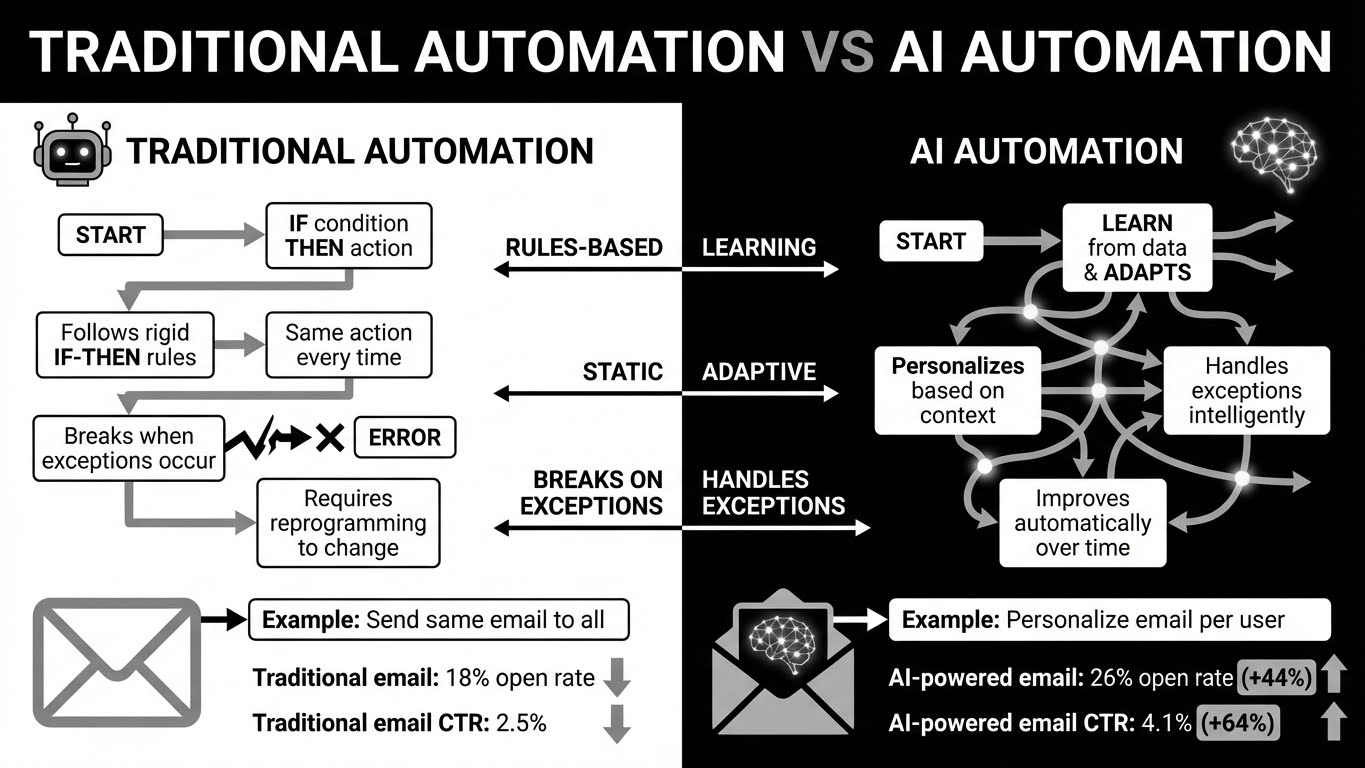
AI automation for business uses artificial intelligence to perform tasks that traditionally required human thinking and decision-making. Unlike traditional automation that follows rigid if-then rules, AI automation learns from data, understands context, and improves over time without reprogramming.
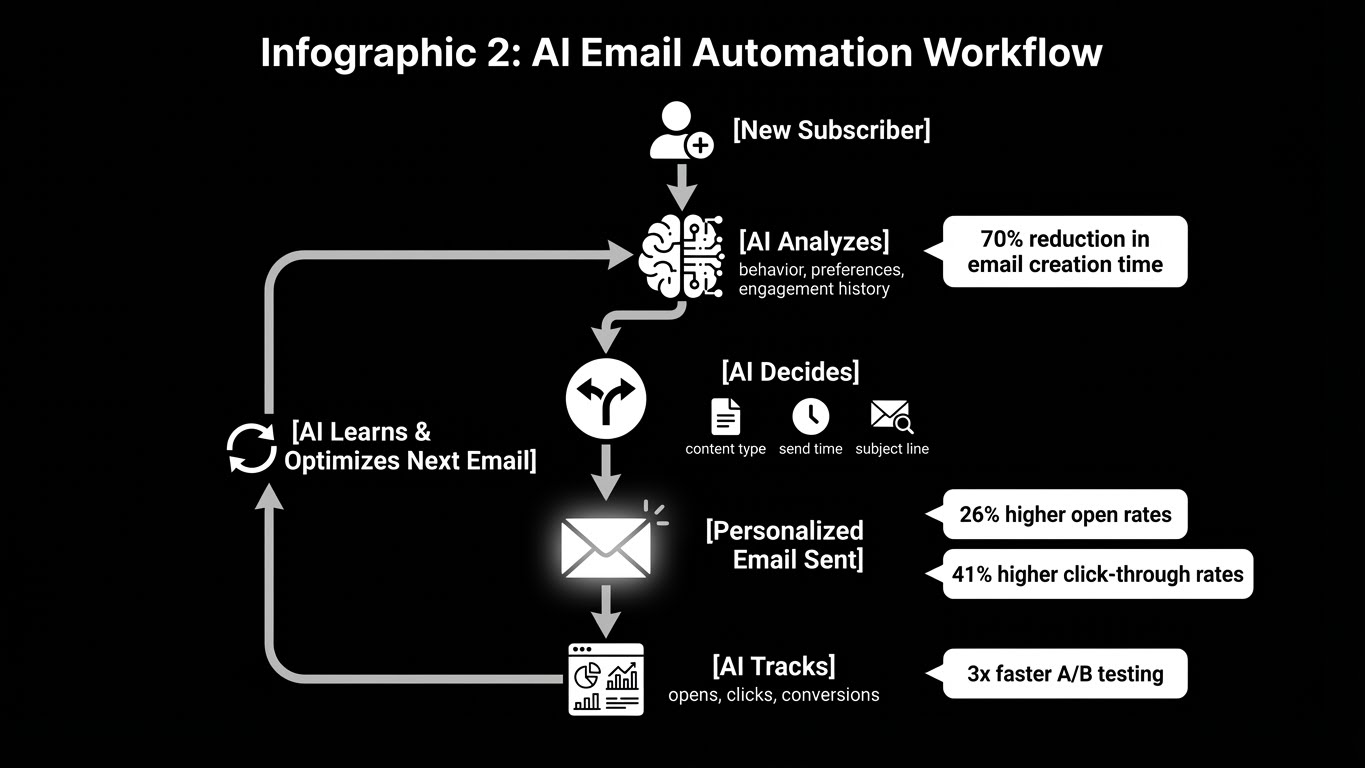
Think of the difference this way: Traditional automation sends the same email to every new subscriber. AI automation analyzes each subscriber's behavior, interests, and engagement patterns to send personalized content at the optimal time for that specific person.
The result? AI-powered emails see 26% higher open rates and 41% higher click-through rates compared to generic automated sequences.
Why Every Business Needs AI Automation in 2025
The numbers tell the story. According to McKinsey, businesses that adopt AI see profit margins 3-15% higher than competitors who don't. Gartner predicts that by 2026, 80% of enterprises will have deployed AI automation in some form.
But the real driver isn't fear of missing out—it's the tangible results business owners see every day:
- Customer service AI handles 80% of routine inquiries, freeing staff for complex issues
- AI email tools save 10+ hours per week on writing and scheduling
- Predictive analytics reduce inventory costs by 20-30%
- AI chatbots convert 3x more website visitors into leads
- Automated data entry eliminates 90% of human errors
“We implemented an AI chatbot expecting to save maybe 5 hours a week. It ended up handling 73% of our customer inquiries and freed up our entire support team to focus on sales.” — Small business owner on Reddit
1. AI Chatbots for Customer Service
AI chatbots have evolved far beyond the frustrating “I didn't understand that” bots of the past. Modern AI chatbots powered by large language models can understand context, remember conversation history, and provide genuinely helpful responses.
The business impact is substantial. Companies using AI chatbots report 70% reduction in response time, 80% of queries resolved without human intervention, and 35% improvement in customer satisfaction scores.
Best of all, AI chatbots work 24/7. That customer who visits your website at 2 AM gets the same quality response as someone visiting during business hours. For businesses with international customers, this alone can transform conversion rates.
Tools to try: Intercom, Drift, Tidio, or custom ChatGPT-powered solutions. Most offer free tiers for small businesses.
2. AI-Powered Email Automation
Email remains the highest-ROI marketing channel, returning $36 for every $1 spent. AI takes email automation to the next level by writing personalized subject lines, optimizing send times for each recipient, and automatically segmenting your audience based on behavior.
AI email tools can analyze your past campaigns to understand what works, then apply those insights to future emails. They can even generate entire email sequences based on a brief description of your goals.
The time savings are significant. What used to take 4-6 hours of email writing and scheduling now takes 30 minutes of review and approval.
Tools to try: Mailchimp with AI features, ActiveCampaign, Klaviyo, or Jasper for email copywriting.
3. Predictive Analytics and Forecasting
Predictive analytics uses AI to analyze historical data and forecast future trends. For businesses, this means knowing which products will sell next month, which customers are likely to churn, and when you'll need to restock inventory.
E-commerce businesses using predictive analytics report 20-30% reduction in excess inventory and 15-25% improvement in cash flow. Service businesses see 40% better accuracy in demand forecasting, allowing them to staff appropriately and avoid both overtime costs and missed opportunities.
The technology has become accessible to small businesses through platforms like Google Analytics 4 (with built-in predictive metrics), Shopify's AI features, and dedicated tools like Pecan AI.
Tools to try: Google Analytics 4, Tableau with Einstein, Pecan AI, or industry-specific solutions.
4. AI Content Generation
AI content tools have transformed how businesses create marketing materials, blog posts, social media content, and product descriptions. What once required hiring writers or spending hours crafting content can now be done in minutes.
The key is using AI as a starting point, not a replacement for human creativity. AI excels at generating first drafts, overcoming writer's block, and scaling content production. Humans add the brand voice, fact-checking, and strategic thinking.
Businesses report 70% reduction in content creation time while maintaining or improving quality. The freed-up time goes into strategy, promotion, and engaging with customers—activities that directly drive revenue.
Tools to try: ChatGPT, Claude, Jasper, Copy.ai, or Writesonic.
5. AI Lead Scoring and Qualification
Not all leads are created equal. AI lead scoring analyzes dozens of signals—website behavior, email engagement, company size, job title, and more—to predict which leads are most likely to convert. Your sales team can then focus their energy on high-probability opportunities.
The impact on sales efficiency is dramatic. Sales teams using AI lead scoring report 30% higher conversion rates and 20% shorter sales cycles. They spend less time chasing dead ends and more time closing deals.
AI can also automatically route leads to the right salesperson based on expertise, availability, and past performance with similar accounts.
Tools to try: HubSpot, Salesforce Einstein, Pipedrive, or MadKudu.
6. Intelligent Document Processing
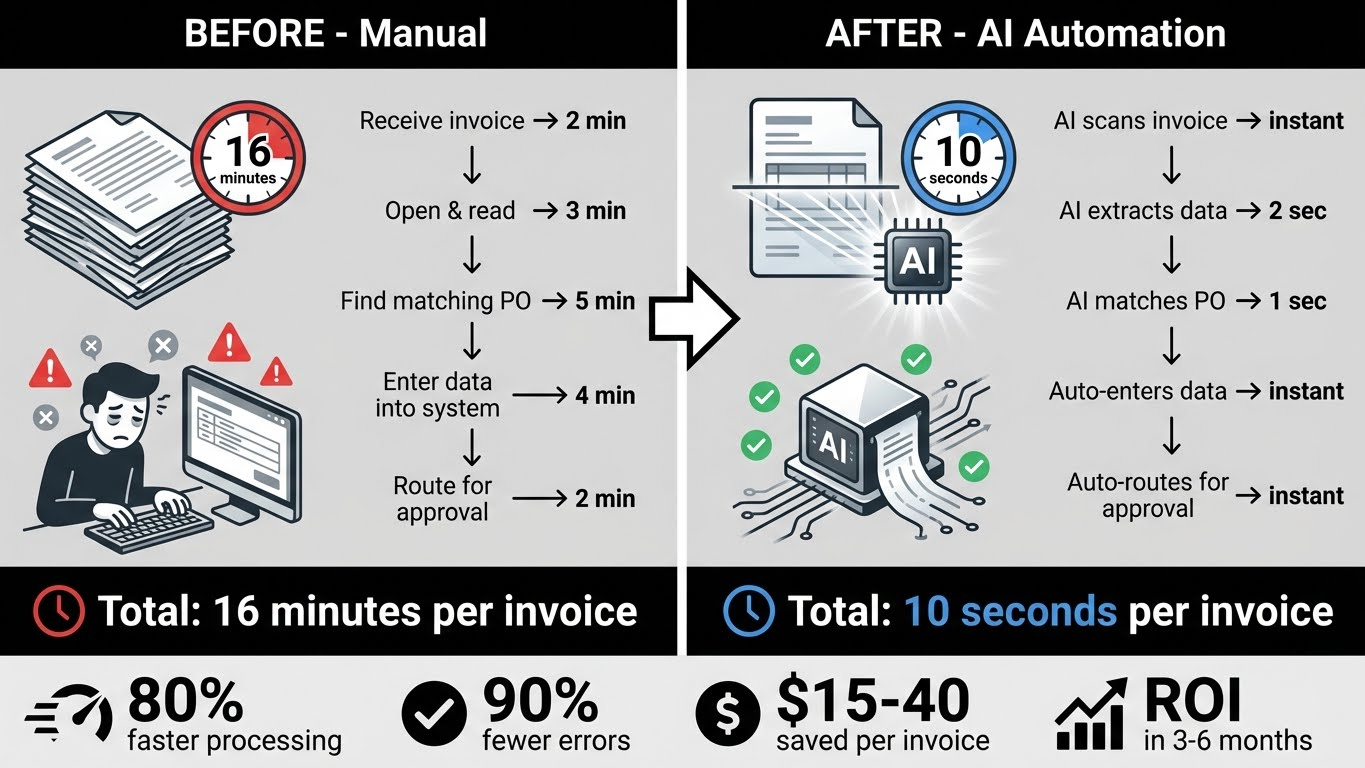
AI document processing extracts data from invoices, receipts, contracts, and forms automatically. No more manual data entry, no more typos, no more hours spent on paperwork.
Modern AI can understand document structure even when formats vary. It recognizes that “Total Amount” and “Amount Due” and “Balance” all mean the same thing. It can process handwritten notes, scanned documents, and photos of receipts.
Businesses using AI document processing report 80% reduction in processing time and 90% fewer errors compared to manual entry. For accounts payable alone, this translates to $15-40 saved per invoice processed.
Tools to try: DEXT, Rossum, Nanonets, or built-in features in QuickBooks and Xero.
7. Smart Scheduling and Calendar Management
AI scheduling tools go beyond basic calendar booking. They learn your preferences, understand meeting priorities, automatically find optimal times across time zones, and can even reschedule conflicts without your intervention.
For businesses with client-facing roles, AI scheduling eliminates the back-and-forth of finding meeting times. Clients book directly into available slots, receive automatic reminders, and can reschedule without involving your staff.
The hidden benefit is reduced no-shows. AI-powered scheduling with automated reminders typically reduces no-shows by 30-50%, directly impacting revenue for service businesses.
Tools to try: Calendly, Cal.com, Reclaim.ai, or Motion.
8. AI Inventory Management
AI inventory systems predict demand based on historical sales, seasonality, market trends, and even weather patterns. They automatically generate purchase orders when stock reaches optimal reorder points, preventing both stockouts and excess inventory.
The financial impact is significant. Excess inventory ties up cash and risks obsolescence. Stockouts mean lost sales and disappointed customers. AI finds the sweet spot, optimizing inventory levels to maximize both cash flow and sales.
E-commerce businesses report 20-30% reduction in inventory costs and 40% fewer stockouts after implementing AI inventory management.
Tools to try: Cin7, TradeGecko/QuickBooks Commerce, Ordoro, or Shopify's built-in AI features.
10. AI Financial Automation
AI financial tools automate bookkeeping, expense categorization, invoice processing, and financial forecasting. They learn your business patterns and can flag anomalies, predict cash flow issues, and even suggest ways to optimize spending.
For small business owners, this means spending less time on financial admin and more time on growth. AI can categorize transactions with 95%+ accuracy, reconcile accounts automatically, and generate financial reports on demand.
The real value is in insights. AI can identify spending trends, flag unusual transactions, and provide early warning of cash flow problems—giving you time to act before issues become crises.
Tools to try: QuickBooks with AI features, Xero, Wave, or specialized tools like Vic.ai for larger operations.
How to Get Started with AI Automation
The key to successful AI automation is starting small and scaling based on results. Don't try to automate everything at once. Pick one high-impact area, implement it well, measure the results, then expand.
Here's a proven approach:
- Identify your time drains. What repetitive tasks consume the most hours each week? Start there.
- Research existing tools. Most AI automation needs can be met with existing software. Custom solutions are rarely necessary.
- Start with free trials. Test 2-3 tools before committing. Most offer free tiers or 14-day trials.
- Measure baseline metrics. Know your current performance so you can quantify improvements.
- Implement and iterate. Launch with one process, learn from it, then expand to the next.
“The businesses that succeed with AI automation are the ones that start with clear goals, not cool technology. Know what problem you're solving before you pick a tool.”
Frequently Asked Questions
What is AI automation for business?
AI automation for business uses artificial intelligence to perform tasks that traditionally required human intervention. This includes chatbots handling customer inquiries, AI analyzing data for insights, machine learning predicting sales trends, and natural language processing automating email responses.
How much can AI automation save my business?
Businesses implementing AI automation typically save 20-40 hours per week and reduce operational costs by 25-40%. Most businesses see ROI within 3-6 months, with first-year returns of 300-500%.
Is AI automation difficult to implement?
Modern AI automation is surprisingly easy. No-code tools allow anyone to create AI workflows. Pre-built AI chatbots can be deployed in hours. Most businesses can have their first AI automation running within 1-2 weeks.
Will AI automation replace my employees?
AI automation augments employees rather than replacing them. It handles repetitive tasks so your team can focus on strategic work, relationship building, and creative problem-solving. Most businesses using AI automation grow faster and hire more people.
What business processes should I automate first?
Start with high-volume, repetitive tasks: customer FAQ responses, email sorting, data entry, appointment scheduling, lead qualification, and report generation. These offer the fastest ROI and are easiest to implement.
What's the ROI of AI automation?
AI automation typically delivers 300-500% ROI in the first year. A business saving 15 hours/week at $50/hour equivalent saves $39,000 annually. Add reduced errors and faster customer response, and most implementations pay for themselves within 3-6 months.
Ready to Automate Your Business with AI?
We build custom AI automation solutions at 70% less than US agency rates. Get a free consultation to identify your highest-ROI automation opportunities.
9. AI Social Media Management
AI social media tools analyze your audience, competitors, and industry trends to recommend optimal posting times, hashtags, and content types. They can generate caption suggestions, repurpose content across platforms, and even respond to comments.
The consistency benefit is huge. Most businesses struggle to post regularly because content creation takes time. AI tools can generate a month's worth of content in an afternoon, maintaining your social presence even during busy periods.
Social media managers using AI tools report 60% time savings while actually increasing posting frequency and engagement rates.
Tools to try: Buffer with AI, Hootsuite, Later, or Publer.